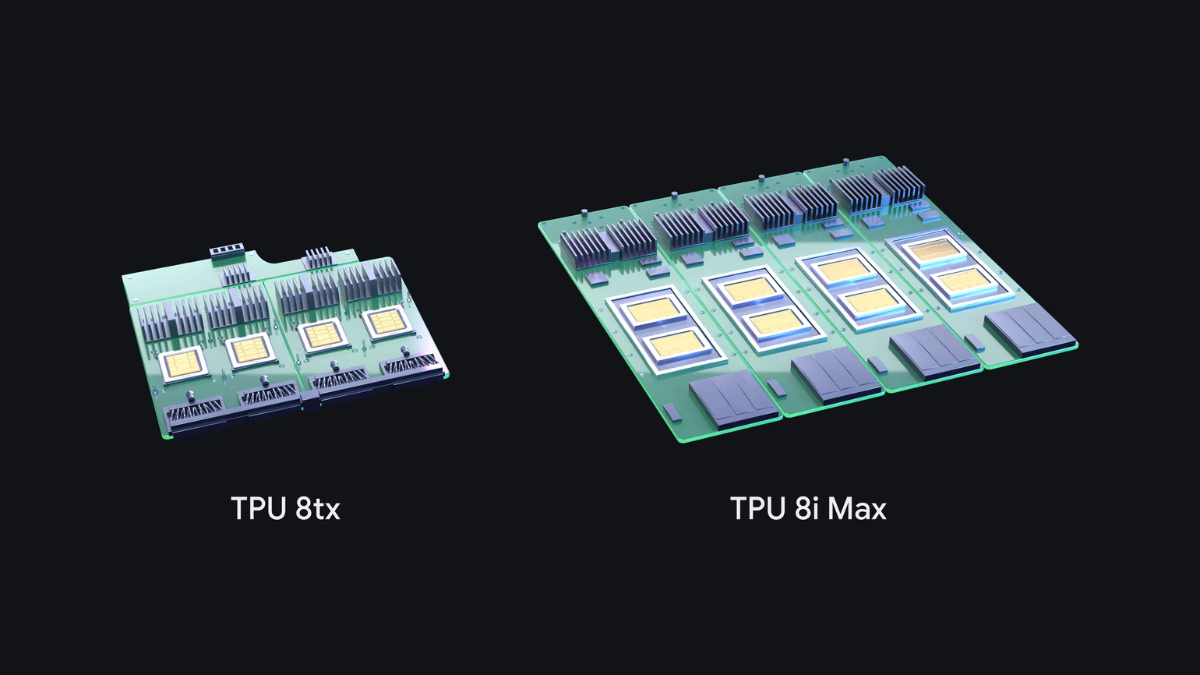
On Wednesday, Google unveiled the 8tx and 8i Max—two new systems within its eighth-generation Tensor Processing Unit (TPU) lineup. With these additions, the Mountain View-based tech giant now offers four eighth-generation TPU variants, joining the previously released TPU 8t and 8i. Google first introduced its eighth-generation TPU series at the Google Cloud Next conference this past April, initially launching with two models. The company noted that this release marks the first time it has introduced four distinct TPU systems in a single year. The new TPU 8tx and TPU 8i Max are designed for confidential computing and large-scale, high-density context processing, respectively.
Google Introduces TPU 8tx and TPU 8i Max for Confidential AI Inference
In a blog post, Google detailed its two new specialized TPU systems: the TPU 8tx and the TPU 8i Max. The TPU 8tx is purpose-built and optimized for secure, confidential AI inference; the company also notes that it can be used for small-scale AI model training. Targeted at regulated enterprises and government agencies, the TPU 8tx is designed to help these organizations run cutting-edge or proprietary AI models—as well as autonomous AI agents—while ensuring the security of their sensitive data.
The TPU 8tx is paired with fifth-generation AMD EPYC CPU hosts and utilizes the same underlying chip as the 8t model released earlier this year. Google states that the TPU 8tx incorporates security mechanisms directly into the hardware, protecting and isolating sensitive data and model weights during active use. Furthermore, it features a low-latency “Boardfly” interconnect for real-time inference, offering twice the speed (lower latency) of the TPU 8t with “virtually zero performance overhead.” The TPU also enables users to fine-tune AI models using private data, partition large AI models into smaller components, and train AI agents via reinforcement learning.
On the other hand, the TPU 8i Max system is designed specifically for “massive” context windows and the “highest rack-level compute density.” The system reportedly enables synchronous scaling of both compute and memory, doubling compute capacity, SRAM bandwidth, and HBM bandwidth. Furthermore, the TPU system is said to accommodate twice as many chips within existing racks, allowing data centers to “significantly increase compute capacity per square foot and per watt.”
As with previous systems, the tech giant co-designed the new 8i Max and 8tx TPUs with Google DeepMind. However, the company states that it also incorporated feedback and input from external entities, such as certain “highly” regulated cloud customers.